Monday, September 21, 2015
House of Cards
Monday morning, and I have my writing plan for the week. To keep myself on task, I set up assignments for each day, and each day's writing is dependent on finishing the work of the previous day. Revise a story, post a blog, outline a new draft, check over submission possibilities, send work out. In my mind, at least, it's a logical and orderly process.
Furthermore, setting specific goals is my way of combating procrastination, the bane of any writer's existence. It's so easy to procrastinate. Household chores beckon, there's something I need at the store, Woki gives me a "let's go for another walk" stare. Ten thousand distractions. But I won't be tempted because I have my plan.
Until I don't.
The photo I took yesterday (on my brand new phone) for the blog post I want to write isn't syncing to my computer. In fact, my entire photo library seems to have a major issue, which stems suspiciously from the acquisition of the new phone. Apple Care can't solve the problem and the earliest available appointment with the Genius Bar isn't until Thursday afternoon. #&%!$!, as they used to say before cussing became basic to contemporary vocabulary.
So my carefully constructed plan is in the crapper. Just trying to set up a time to get the trouble fixed--never mind actually fixing it--has trashed my schedule. My house-of-cards writing plans have fallen like, well, a house of cards, and walking another 6 miles, mowing the lawn, or cleaning out the gutters has taken on unexpected appeal.
Flexibility has never been my strong suit, but I need to focus on writing, not leaf-clogged gutters. Ergo, this entire post is an exercise in working through the issue. Photo courtesy of Morguefile.com, and text akin to moldy, rotting gutter slime, here it is. Old dogs and penmonkeys can learn new tricks.
But now, perhaps, it's time for a walk.
Monday, August 17, 2015
Outside, Looking In
This photo was taken in Unionville, MI, a town I drove through this summer that was unique for its abandonment. Shop after shop stood shuttered and neglected, furniture and merchandise left behind along with hopes and dreams. My reflection is just visible at the edge of the dusty window as I stood snapping pictures, sad for the economic downturn of this once vibrant town and state.
Naturally, my imagination began to spin stories: who owned the glassware? Was it the pride and joy of a farmer's wife, or the everyday pieces used in the grand home of a lumber or auto baron? And what would become of these things now? The fate of these delicate, gentle reminders of a bygone era when families took the time to sit at a table, perhaps enjoying the rare treat of ice cream served in a graceful shell-pink glass dish, troubled me.
I believe it was Chekhov who, when asked where he got ideas for his stories, replied, "Everywhere." Then, he picked up a nearby ashtray and said if he was so inclined, he could write a story about it. He would have had a field day with the glassware in this shop window.
Indeed, there are stories everywhere, but it seems the ideas for them come most often from observing something from physical or emotional distance. It's not always a comfortable place, but it affords a perspective that "insiders" rarely have.
One of my oldest friends recently criticized a description of boarding school life in one of my books. She attended boarding school; I did not. I paraphrase, but she said something like, "You were in our group, but not really of it."
Fair enough, and true enough, but that doesn't mean I don't know what I'm talking about. My perspective, I believe, is broader than her fond and particular memories and, by virtue of the fact that I wasn't of the group, I had a more fluid point of view. Forest for the trees sort of thing.
It's what writers do. We stand on the outside, looking in, and report on the world as we see it.
Naturally, my imagination began to spin stories: who owned the glassware? Was it the pride and joy of a farmer's wife, or the everyday pieces used in the grand home of a lumber or auto baron? And what would become of these things now? The fate of these delicate, gentle reminders of a bygone era when families took the time to sit at a table, perhaps enjoying the rare treat of ice cream served in a graceful shell-pink glass dish, troubled me.
I believe it was Chekhov who, when asked where he got ideas for his stories, replied, "Everywhere." Then, he picked up a nearby ashtray and said if he was so inclined, he could write a story about it. He would have had a field day with the glassware in this shop window.
Indeed, there are stories everywhere, but it seems the ideas for them come most often from observing something from physical or emotional distance. It's not always a comfortable place, but it affords a perspective that "insiders" rarely have.
One of my oldest friends recently criticized a description of boarding school life in one of my books. She attended boarding school; I did not. I paraphrase, but she said something like, "You were in our group, but not really of it."
Fair enough, and true enough, but that doesn't mean I don't know what I'm talking about. My perspective, I believe, is broader than her fond and particular memories and, by virtue of the fact that I wasn't of the group, I had a more fluid point of view. Forest for the trees sort of thing.
It's what writers do. We stand on the outside, looking in, and report on the world as we see it.
Wednesday, July 22, 2015
Visitations from the Past
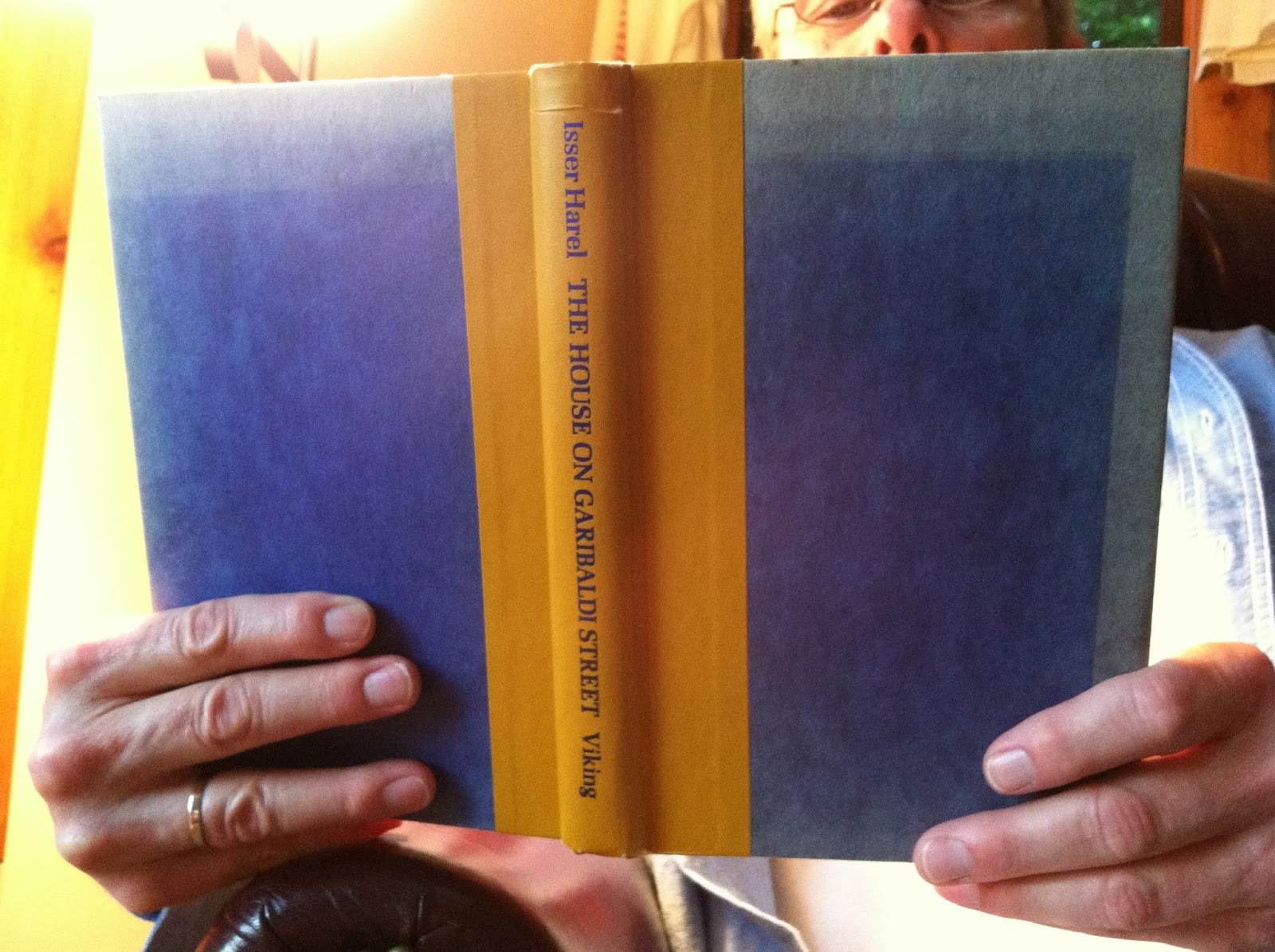
Inside the sun-bleached cover, the pristine pages are thick and oatmeal-y, a quality uncommon in recent publications. The author, Isser Harel, was born in 1912. The events of the non-fiction account of the capture of Adolf Eichmann occurred in the 1940s and 50s. My husband purchased the book--new--in 1975. For forty years, it sat on a shelf in his office, unread. But here's the thing about books: they don't lose their value or relevance over time. Two weeks ago, he picked up The House on Garibaldi Street (Viking Press, 1975) and began reading a chapter or two each evening. The third night, he thrashed in the grip of a nightmare, literally screaming in his sleep.
I haven't read the book, but I get the general context, and there is plenty of nightmare-inducing material. Coincidence or not (and I don't believe in coincidence), I'm also reading about events from World War II, researching a short story I feel compelled to write. The story is based on a railway disaster in England (Soham Railway Disaster June 2, 1944) but is germane to recent railway crashes here and in Canada. This is my first attempt at historical fiction, and immersing myself in the details of that era has fomented my own night terrors of running through the woods, hiding from jack-booted thugs.
There are probably multiple reasons that the Harel book and my WWII story have swirled out of the mists of time to haunt us now. That era has always held fascinations, both nostalgic and terrifying. Everyone knows revisiting the past offers important lessons for the future, but is anyone paying attention? Though I prefer to steer clear of politics, given the current crop of buffoons and jack-a-napes running for the highest office in this land, I'm alarmed. Hitler wasn't taken seriously at first, either.
We need our stories of the past, the present, and the future to remember where we've been and hopefully, to light a safe and sane path to the future. Every day, when I sit in my little office, with my imaginary friends, it's my goal to carve out such a path, even it it's only for myself. Given the power of the written word, if I'm good enough and lucky enough, that might not be a complete waste of time.
Thursday, June 18, 2015
Distractions
I'm currently working on a short story that that's driving me bat-shit crazy and underscoring the reason so many writers are drawn to large quantities of alcohol. The part of my brain that has turned to bat guano longs to wallow in a vat of good Russian vodka. Fortunately, saner cells still prevail.
Sort of.
Instead of booze, I often indulge in math problems in an attempt to distract myself from the stalled story line, the underdeveloped characters, and perturbations that have no apparent resolution. Math problems are generally solvable, allowing me some sense of accomplishment. And the pay is comparable to writing short stories for publication.
I ran across the above problem in my files the other day and spent the better part of yesterday solving it in hopes the Universe might get the message. Obviously, each letter stands for a number and the object is to figure out what those letters are so the addition works out. Try it--I double dog dare you.
P.S. It's a lot easier to figure out than the plot of a good short story.
Sunday, May 17, 2015
No Accountin' For It
I took the above photo to illustrate an issue that I grapple with on a regular basis. The way art is perceived is so subjective that I often find myself in a head-scratching, "huh? what?" frame of mind. There are so many artists, writers and performers who never get the break they deserve, but conversely, there are too many who get recognition for stuff that sends my aesthetic dander to the stratosphere.
The sculpture above sits at a public building in my town and undoubtedly cost a packet of money to have commissioned and installed. Yet, gratis, my dog produces nearly identical work every morning on my front lawn. In whose eyes does the bronze version look like anything worthy of commemoration?
The New York Times list of best selling fiction is rife with titles that are the literary equivalent of Mountain Dew. These books might give you a quick rush, but they'll rot your teeth. They are financial angels for author and publisher, but demons for readers. Fifty shades of high-priced marketing will, clearly, put any kind of sleazy, hackneyed crap on the best-seller list.
Where are the emperor's clothes?
Last week, the Art Institute conferred an honorary doctorate upon Kanye West. Really? The Chicago Tribune sang his praises with an op-ed piece titled "The Brilliant Kanye West" and described him as a "creative and wide-ranging thinker." Really? This is a guy who boasts about not reading. And don't even get me started on the ah, attributes of his wife and her family.
Great diversity in culture should be encouraged and celebrated, but the operative word is culture. Culture: "the act of developing the intellectual and moral faculties especially by education"--Merriam Webster Could someone please explain either the intellectual or moral merits possessed by Mr. West?
Oh, wait, it's all about the marketing, isn't it?
I recall that grand old adage, somewhat revised for this post: one person's art is another person's dog shit.
Saturday, April 25, 2015
Promo, Promo
This may look like an ordinary display of books with my newest, TWELVE THOUSAND MORNINGS, front and center, but this display is at the LONDON BOOK FAIR. Kudos to my wonderful agent, April Eberhardt, for her work with the 2 Seas Literary Agency in getting my book to this mega event. How I would love to be there myself!
BTW, the book just to the left of mine, THE VINTNER'S DAUGHTER, by Kristen Harnisch, is a wonderful, beautifully written story. I highly recommend it, and I'm looking forward to her next book, due around the end of the year.
Wednesday, April 1, 2015
The Madison Conference
In 2013, when I first began writing TWELVE THOUSAND MORNINGS, I set a goal for myself: have the book published and ready to take to the best writing conference in the Midwest. I'd been to Writers' Institute at UW Madison twice before--the first time, I met my fabulous agent, April Eberhardt, and the second time, she and I were invited to give a presentation on our non-traditional agent/author relationship.
I met my goal, launching TTM on March 12, and left for Madison, books in tow, on March 26th. In the photo above, I am behind the table (gray sweater & pearls) and April is standing to my left. This was the opening ceremony, with all presenters on stage.
The weekend was terrific. I can't say enough about how well-organized this conference is. Laurie Scheer and her team are efficient, thorough, and unfailingly cheerful and polite. The venue (Madison Concourse Hotel) is lovely, and the presentations are interesting, informative, and cater to beginning writers as well as those with a lot of experience. I wish I had been able to go to every presentation offered.
In addition to a talk that April and I gave on our continued work together, I also gave two workshops, one titled "Seven Habits of Highly Effective (Imaginary) Characters" and another on "Editing for the Faint of Heart." In this second presentation, I stressed the need for proofreading and editing, since poorly edited work is bad news for everyone. I'm pleased to say that all my advice was well-received, and I came home feeling quite proud.
In addition to the honor of being an instructor at this excellent conference, I also had the pleasure of seeing one of my short stories published in the literary journal (Midwest Prairie Review) associated with Writers' Institute. The minute I got home, I showed my husband the high-quality print journal, pointing out my story with great delight.
And there is where I learned once again that the old adage "pride goeth before a fall" applies as ever, for smack in the middle of my story sat the ugly toad of a major typo. I cringe thinking of the people who took notes in my editing lecture finding that error and wondering why I don't follow my own advice.
Subscribe to:
Posts (Atom)